AI Agent Partner
From a helper panel to a conversational partner
Agent Helper helped agents read a case. AI Agent Partner is conversational: it helps them decide and act, from cited replies to escalating in Jira, swarming in Slack and scheduled follow-ups.
Why we built it
Agent Helper made the case easier to read. But agents still left the case to get help, chase engineering in Jira, pull experts into Slack and remember follow-ups. AI Agent Partner set out to help them decide what to do next and then do it, in one conversation.
Why a partner, not just a helper
Agent Helper answered "what is this case about?" The next question agents kept asking was "what do I do now, and who do I need?" That needed a conversation with the case, connected to the tools where support work actually happens.
| Agent Helper | AI Agent Partner | |
|---|---|---|
| How agents use it | A panel of summaries, cards and related content | A conversation: ask in plain language, get answers and actions |
| Main job | Read the case faster and draft a reply | Decide the next step and carry it out |
| Context | Case summary, timeline and related content | The case timeline plus connected tools such as Jira and Slack |
| Getting help | Related experts listed in the panel | Escalate in Jira or swarm via Slack without leaving the case |
| Follow-through | Agents track follow-ups themselves | Schedule follow-ups from the conversation |
| Evidence | Related articles and cases | Cited sources beside each suggestion |
| Where it's heading | Assistive panel | An autonomous agent for basic L1 cases |
Customer story: Revenera
Customer outcome · Revenera's Agent Helper deployment
Revenera's technical support team handles complex cases such as licensing disputes, installation failures and compliance audits. Instead of adding headcount, they embedded Agent Helper in their support console. In our AI Agent Partner webinar, Revenera's Director of Technical Support shared that impact and what agents still need as cases get more complex, which is the gap AI Agent Partner is built for.
Revenera's reported results with Agent Helper, from SearchUnify's customer case study. They are not AI Agent Partner metrics. Read the Revenera case study (opens in a new tab)
What I owned
I owned the product across case assessment, response assistance, recommended next actions, and adoption and feedback reporting.
Case assessment
A read of where the case stands: what the customer asked, what has been tried, and what is still open.
Response assistance
Suggested replies grounded in the case and in cited knowledge sources the agent can open before sending.
Recommended next actions
One clear next step, such as requesting logs or escalating, with the reason it was suggested.
Adoption and feedback reporting
Reporting that shows managers and our team which suggestions agents use, edit or reject.
Feature list
Conversational
Agents ask about the case in plain language and get answers grounded in its timeline.
Case assessment
Where the case stands: what the customer asked, what has been tried and what is still open.
Cited response assistance
Suggested replies with sources the agent can open before sending.
Recommended next actions
One clear next step, with the reason it was suggested.
Jira integration
Linked Jira issues and their status stay visible in the conversation, so agents know where engineering stands.
Escalate in Jira
Raise an engineering escalation in Jira from the conversation, with the case summary and logs attached.
Swarm via Slack
Pull the right experts into Slack with the case context already shared.
Scheduled follow-ups
Set a follow-up from the conversation so nothing slips.
Adoption and feedback reporting
Shows which suggestions and actions agents use, edit or reject.
See it in a conversation
Try a prompt
What's blocking this case?
The customer gets a 401 on every webhook retry since Friday. That usually means the signing secret was rotated [1]. Logs are attached, but no fix has been offered yet.
Escalate this to engineering in Jira
Created a Jira escalation for the platform team with the case summary, error pattern and logs attached. I'll post status changes here.
Pull in the platform team on Slack
Started a swarm in the platform support channel with the case summary and the Jira link. I'll post their replies here.
Follow up Thursday if the customer is quiet
Follow-up scheduled for Thursday morning. I'll draft it with the latest status from Jira.
Timeline as context, sources as proof
The case timeline is the copilot's context. Every customer message, agent reply, status change and sentiment shift is ordered in time, so the copilot reasons over what happened in the case instead of the last message alone.
Each suggested reply lists its sources. Agents told us they would only send a draft they could check, so citations sit next to the sentence they support.
Case timeline (context)
- Customer Webhook deliveries failing since Friday
- Agent Asked for endpoint and error codes
- Customer 401 on every retry. Escalating if not fixed today.
- Status: Waiting on support · sentiment falling
Copilot suggestion
- [1] KB: Webhook authentication errors
- [2] Similar resolved case, same error code
Next action: Request the delivery log ID, because the error is consistent across retries.
Decisions I owned
Ground suggestions in the timeline
I prioritized timeline context over a larger prompt, so the copilot sees order and change, not a pile of text.
Cite, then suggest
A reply without a source the agent can open is treated as lower confidence and labeled that way.
Measure use, not just output
I defined adoption around what agents did with a suggestion, so the team could tell useful help from noise.
How I measured it
| Measure | Question it answers |
|---|---|
| Draft use | How often do agents start from a suggested reply? |
| Edit depth | How much do they change before sending? |
| Source checks | Do agents open cited sources, and on which kinds of cases? |
| Next-action acceptance | Which recommended actions get taken, and which get dismissed? |
| Escalations, swarms and follow-ups | How often do agents escalate in Jira, swarm in Slack or schedule follow-ups from the conversation? |
| Agent feedback | What do thumbs-down reasons say about missing context? |
Where it's heading
- Today
Suggests
Case assessment, cited replies and recommended next actions.
- Today
Acts when asked
Escalates in Jira, swarms in Slack and schedules follow-ups on the agent's request.
- Future
Resolves basic L1 cases
Runs as an autonomous agent for simple, well-understood L1 cases.
The autonomous L1 agent is a future direction, not a shipped capability.
Watch and read
 VideoVideo short: Disha on AI Agent PartnerSearchUnify on YouTube (opens in a new tab)
 WebinarAI Agent Partner: From Answers to Intelligent Case ResolutionSearchUnify webinar, Oct 2026 · with Revenera (opens in a new tab)
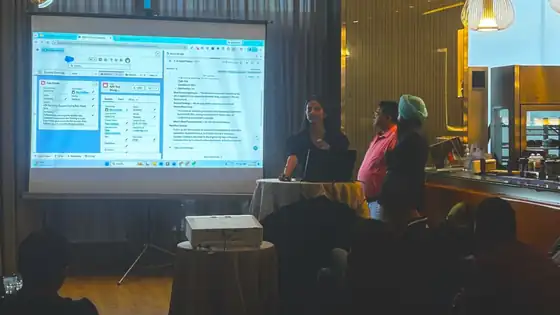 LinkedIn postWhat support leaders told us at our Bengaluru customer roundtableMy LinkedIn post (opens in a new tab)
 Case studyRevenera cuts support resolution time by 55%Customer case study (opens in a new tab)
 VideoRevenera on SearchUnify: Customer PulseCustomer video · Sudheendra Kumar (opens in a new tab)
 WebsiteAI Agent Partner product pagesearchunify.com (opens in a new tab)